Baselines
Baselines define what good looks like for your software. They’re collections of rules that Records should follow—like “must have a README,” “must have tests,” or “must define ownership.”
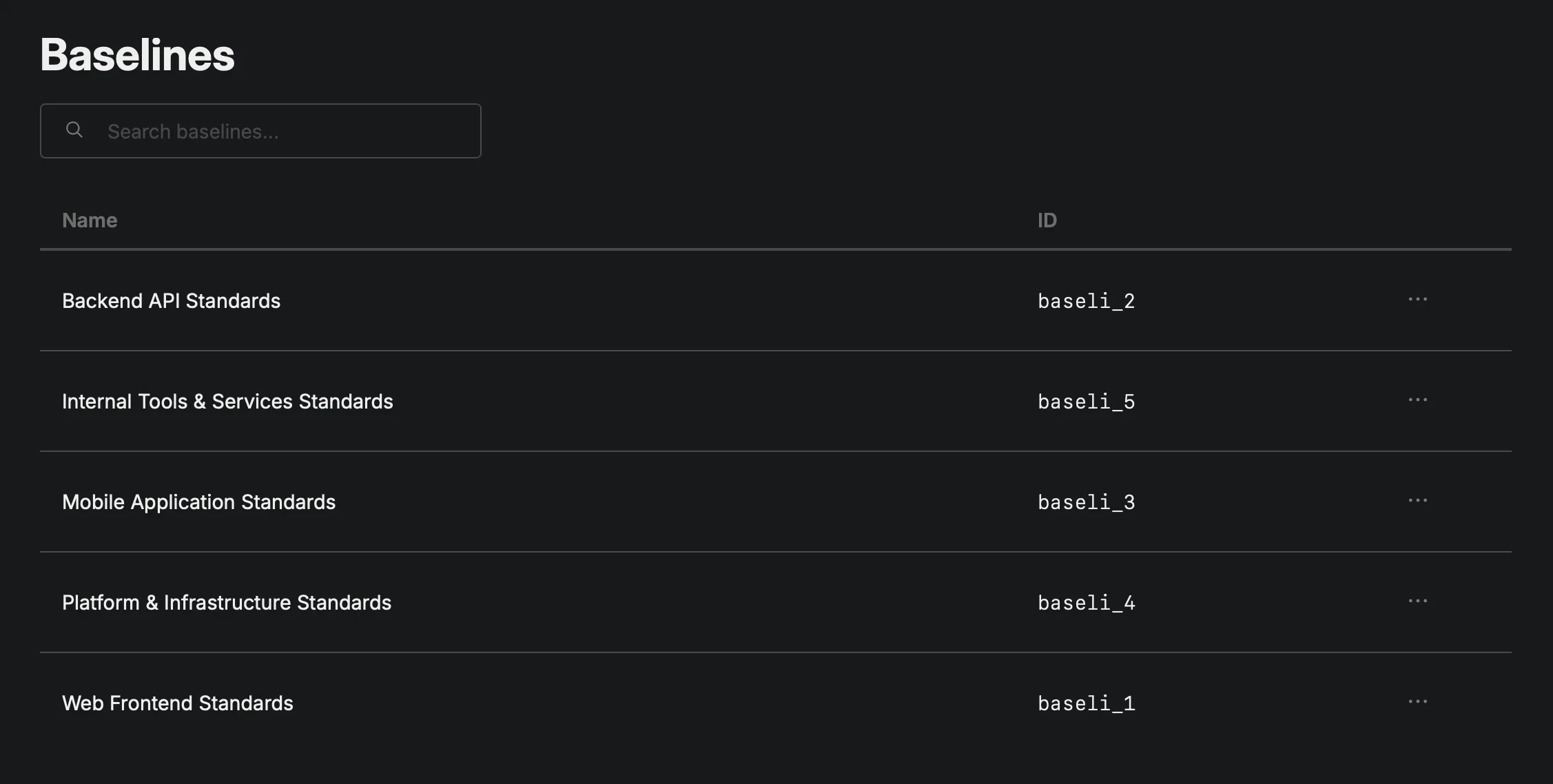
When you run Standards checks against a Record, Phaset uses a Baseline to determine what to check and how strictly to enforce it. Think of Baselines as quality gates that turn implicit expectations into explicit, measurable criteria.
Why Baselines Matter
Section titled “Why Baselines Matter”They make standards explicit. Every team has implicit rules—“we should have tests,” “services need documentation.” Baselines help in making these expectations concrete and checkable.
Instead of each team inventing their own standards, Baselines let you define organization-wide expectations once and apply them everywhere. Different types of software need different standards. A customer-facing API needs stricter standards than an internal tool. Baselines let you define multiple tiers of requirements. Finally, Baselines don’t just measure—they motivate. When Standards checks show 60% compliance, teams have a clear target to improve toward.
Defining Baselines
Section titled “Defining Baselines”Baselines consist of individual checks covering many common areas in software.
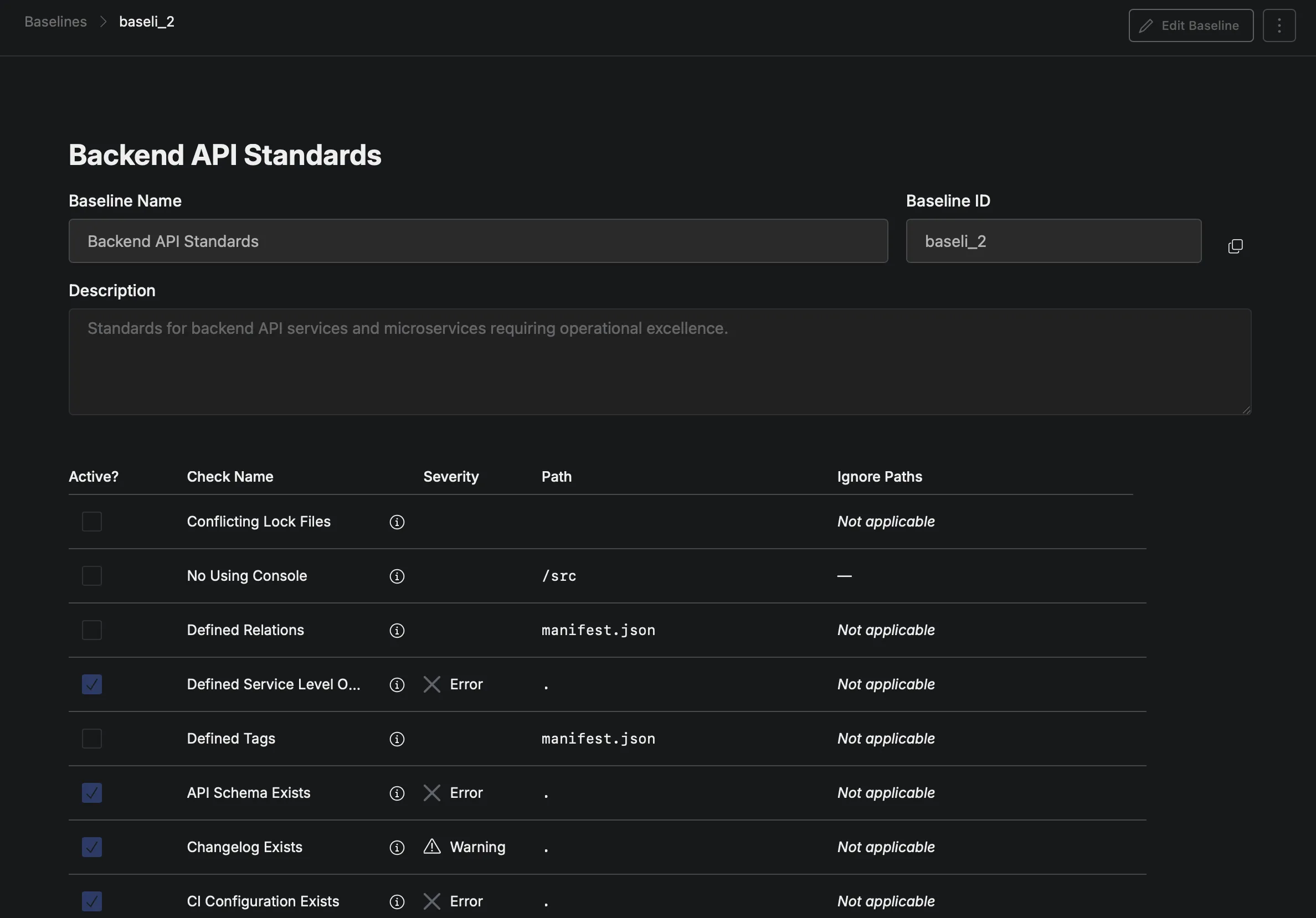
Each check can be set to:
- Error: Must pass (blocks deployment or fails Standards)
- Warning: Should pass (flags for attention but doesn’t block)
- Disabled: Not checked for this Baseline
You can also configure paths and ignore certain files or directories for specific checks.
Getting Started
Section titled “Getting Started”- Create your first Baseline with basic checks (README, tests, CI config)
- Assign it to a few Records as a pilot
- Run Standards checks to see current compliance
- Iterate on the rules based on what’s realistic vs aspirational
- Expand gradually to more Records as teams adopt the standards
Start lenient (warnings, not errors) and tighten over time. Baselines work best when they represent achievable quality bars, not unattainable perfection.
Related concepts
Section titled “Related concepts”- Standards: How Records are scored when checks according to Baselines have been performed