Systems
Systems are a part of Phaset’s metamodeling concepts.
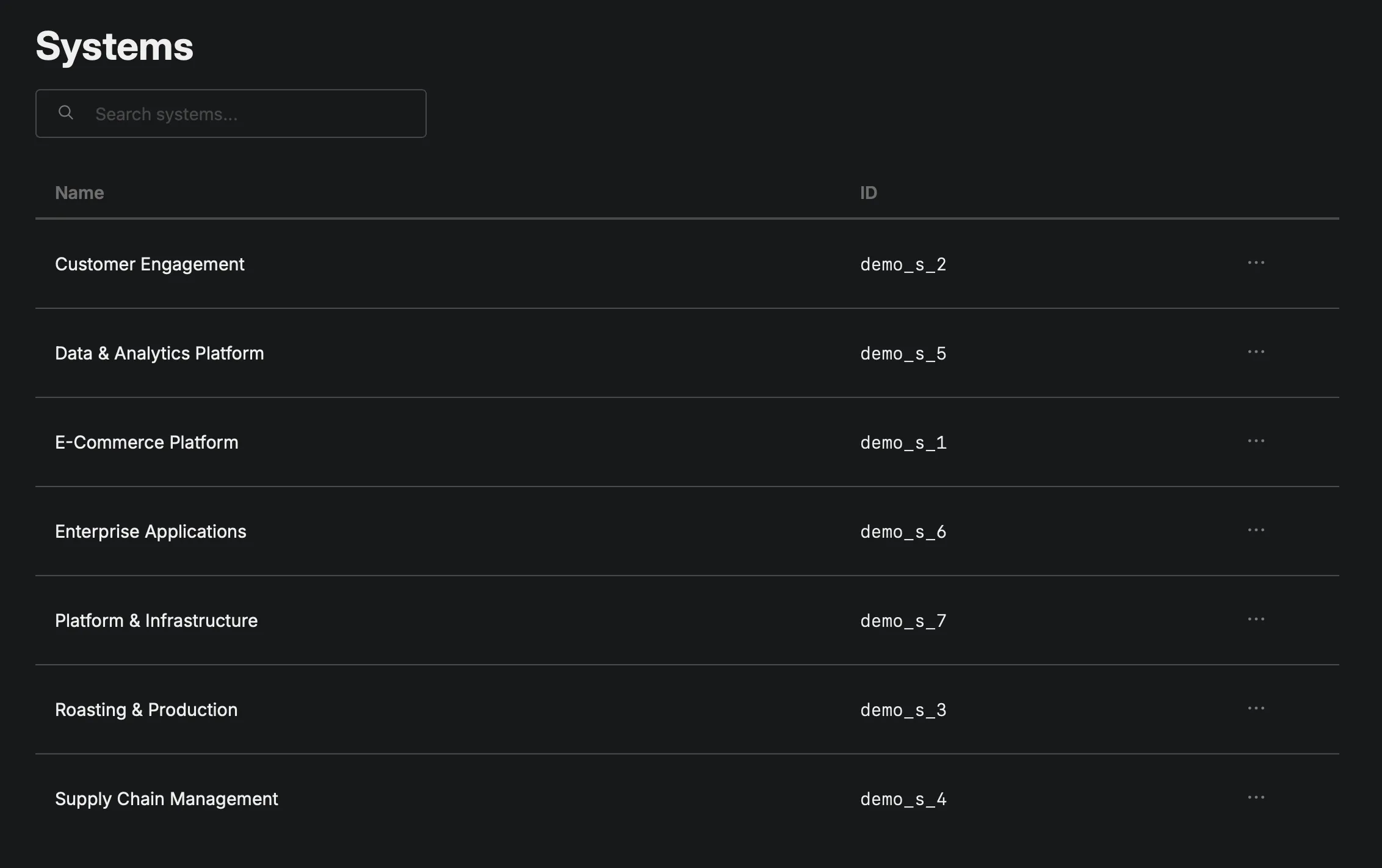
Systems are collections of related Records that work together toward a common purpose. They sit between Domains (business areas) and Records (individual components), providing the middle layer of organization.
Think of a System as answering: “What larger capability does this piece of software contribute to?”
In terms of sizing, a microservice could be a Record. Several microservices working together to handle user authentication form a System.
Why Systems Matter
Section titled “Why Systems Matter”They reveal architectural boundaries because software rarely works in isolation. Systems help you see which components are tightly coupled or depend on each other—critical information for making safe changes. A System typically has a team responsible for its health. When you group a dozen microservices into “User Management,” it’s clear who owns that capability end-to-end.
Need to migrate a database? Understand which System it supports. Planning a major refactor? See all the Records within that System. Debugging an incident? Quickly find all related components. And, now, instead of navigating 200 individual Records, you navigate 20 Systems, each containing only the relevant Records.
Defining Systems
Section titled “Defining Systems”Start by asking: “What logical capabilities exist in our architecture?”
Good Systems are:
- Cohesive: Components within a System work closely together
- Understandable: Non-technical stakeholders grasp what the System does
- Bounded: Clear boundaries about what’s included and excluded
- Owned: A team is responsible for the System’s health
Avoid creating Systems that are:
- Too granular (just duplicates Records)
- Too broad (everything in one System defeats the purpose)
- Technically arbitrary (grouped by programming language or framework)
Getting Started
Section titled “Getting Started”- Identify major capabilities in your architecture
- Create Systems for each capability in Phaset
- Assign Records to their parent Systems
- Use System views to analyze related components together
Systems transform your catalog from a flat list of components into a structured map of capabilities. They help you think architecturally, not just operationally.