What are DORA Metrics?
DORA metrics are the industry standard for measuring software delivery performance—when you understand what they actually tell you.
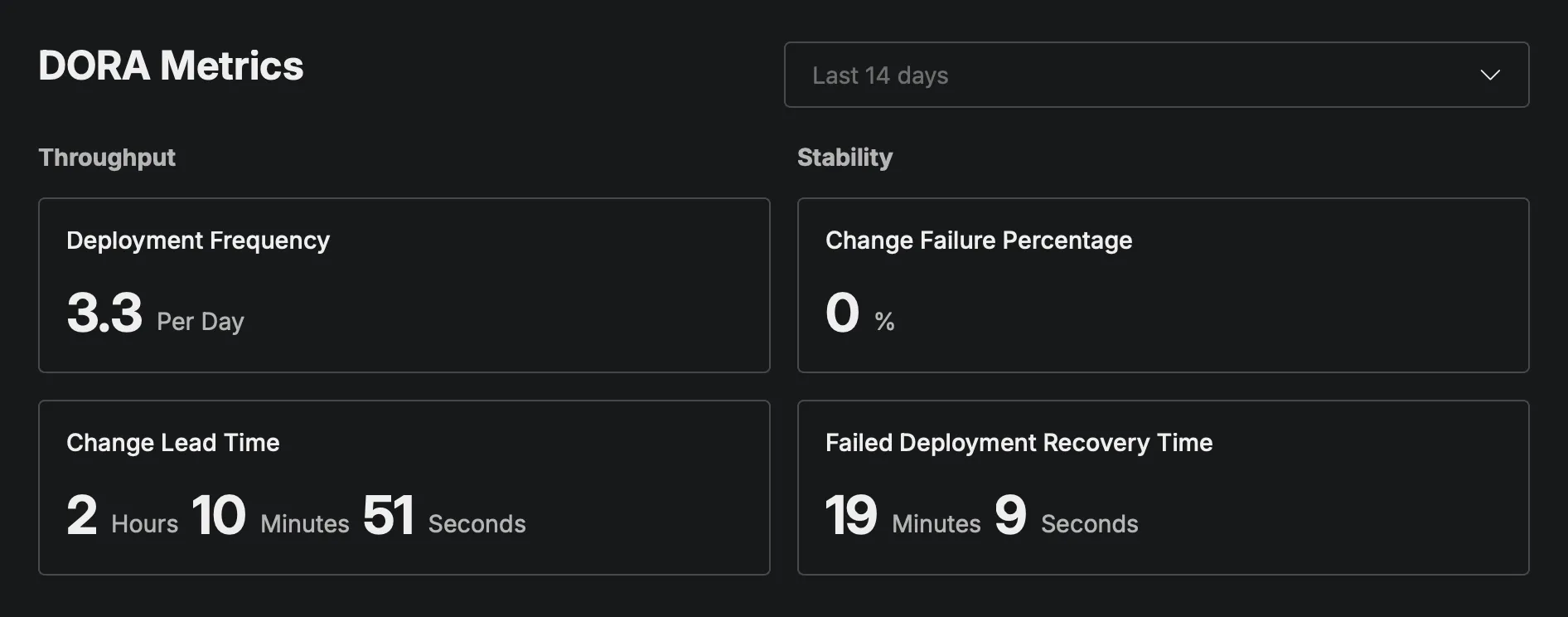
Example DORA metrics visualization, using generated data.
What are DORA Metrics?
Section titled “What are DORA Metrics?”The DORA metrics (DevOps Research and Assessment) emerged from years of research into what separates high-performing software teams from everyone else. Unlike vanity metrics or activity tracking, DORA metrics focus on outcomes that actually matter: how fast you deliver value and how reliably you do it.
The Four DORA Metrics
Section titled “The Four DORA Metrics”DORA metrics are organized into two categories:
Throughput
Section titled “Throughput”Deployment Frequency: How often are you deploying changes to production?
High-performing teams deploy multiple times per day. This enables faster feedback loops, smaller changes (easier to review and less risky), and quick response to issues or opportunities.
Change Lead Time: How long from commit to production?
Lead time reveals friction in your delivery pipeline. Long lead times often point to bottlenecks: slow reviews, manual processes, flaky tests, or deployment anxiety. Shorter lead times mean smooth pipelines and confident shipping.
Stability
Section titled “Stability”Change Failure Rate: What percentage of deployments cause failures?
Failures mean rollbacks, hotfixes, degraded service, or incidents directly caused by a deployment. Low rates indicate effective testing and review processes. High rates suggest you’re moving fast but breaking things—which erodes user trust and team morale.
Time to Restore Service: How quickly can you recover from incidents?
Incidents are inevitable. What matters is resilience. High-performing teams recover in under an hour, while lower-performing teams can take days or weeks. This reflects your observability, incident response processes, and system design.
Why DORA Metrics Matter
Section titled “Why DORA Metrics Matter”They measure outcomes, not activity. DORA metrics don’t care how many lines of code you wrote. They care whether valuable changes reach users quickly and reliably.
Many teams often optimize for one thing (such as speed) at the expense of something else. DORA metrics force you to think about all aspects that make for good software. Fast deployments don’t matter if they constantly break. Stable systems don’t matter if they never ship value.
DORA metrics stem from rigorous research across thousands of organizations with proven correlation to business performance, team satisfaction, and organizational success. Most importantly, they point to problems in your processes and systems, not individual blame. Long lead times? Look at your pipeline. High failure rates? Examine testing. Slow recovery? Improve observability.
How Phaset Approaches DORA Metrics
Section titled “How Phaset Approaches DORA Metrics”Phaset tracks DORA metrics at the Record level—measuring “how is this project performing?” not “who’s slowing us down?” Or in other words: Phaset focuses on delivery systems, not people. This removes surveillance pressure and focuses on team outcomes.
What Phaset needs is standard webhook events from your development workflow—commits, pushes, deployments, and incidents. No invasive access. No code scanning. Just the events that define your delivery flow.
What you get is straightforward, factual data without judgment:
- “You deployed 47 times this month” (not “your team is productive”)
- “Average lead time is 6 hours” (not “you’re 15% slower than industry average”)
- “2 incidents occurred with average recovery time of 45 minutes” (not “your reliability score is poor”)
You get the data. The interpretation and action is yours.
Using DORA Metrics Wisely
Section titled “Using DORA Metrics Wisely”DORA metrics are diagnostic tools, not report cards. They help you ask better questions:
- High deployment frequency but rising failure rate? Maybe moving too fast without adequate testing, or test coverage has gaps.
- Low deployment frequency despite wanting to ship faster? What’s blocking you? Manual approvals? Slow CI/CD? Fear of breaking production?
- Long recovery times from incidents? Do you have good observability? Clear runbooks? Effective on-call processes?
- Improving lead time but deployment frequency staying flat? Organizational bottlenecks? Batch releases? Coordination overhead?
The metrics reveal patterns. The solutions require understanding your context, talking to your team, and addressing systemic issues—not blaming individuals or gaming numbers.
Combined with Engineering Metrics
Section titled “Combined with Engineering Metrics”While DORA metrics focus on delivery performance, engineering metrics provide additional context about team activity and collaboration patterns.
Together they give you a fuller picture:
- DORA: Outcomes (speed and stability)
- Engineering metrics: Work patterns driving those outcomes (review times, collaboration, change patterns)
Phaset provides both, always at the Record level, always with privacy and autonomy in mind.
Why Phaset for DORA Metrics
Section titled “Why Phaset for DORA Metrics”When tracked thoughtfully, DORA metrics help you:
- Identify bottlenecks in your process
- Balance speed with stability
- Make informed decisions about where to improve
- Have productive conversations about delivery performance
Phaset makes DORA metrics easy to track, easy to understand, and focused on systems rather than people—helping you improve your delivery without creating surveillance culture.
Ready to get started? Check out the full Metrics documentation or learn more about engineering metrics.