What are Engineering Metrics?
Engineering metrics aim to answer questions every team cares about: How fast are we shipping? How often do things break? Are we improving? When used well, metrics illuminate patterns and help teams improve. The key phrase is when used well.
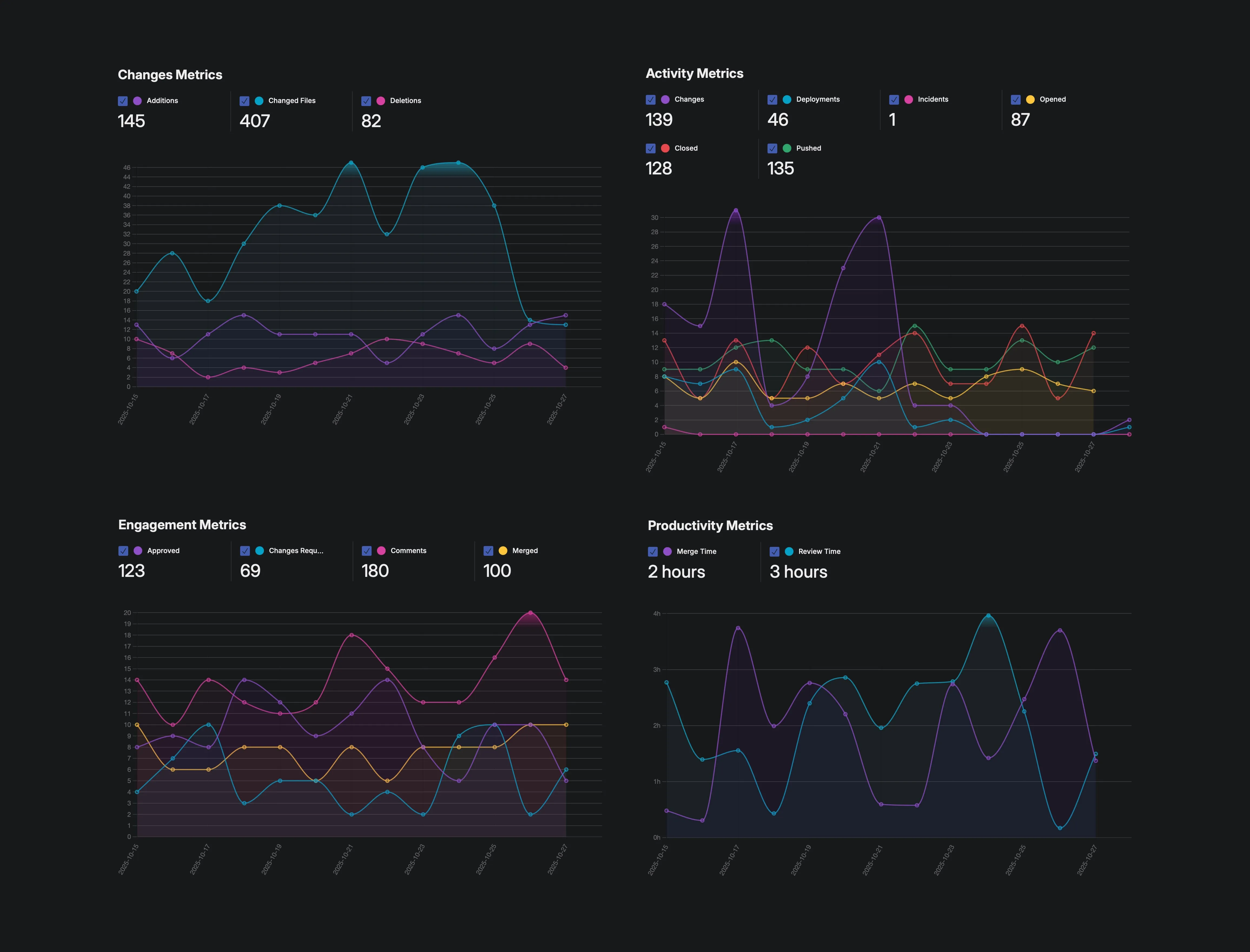
Example engineering metrics visualization, using generated data.
The Problem with Engineering Metrics
Section titled “The Problem with Engineering Metrics”Here’s the uncomfortable truth: engineering metrics are frequently misused, and when they are, they cause real harm.
When individual performance is measured by metrics like lines of code or commit count, people optimize for the metric instead of the outcome. You get bloated pull requests, artificial commits, and work that looks productive on paper but delivers little value. At worst, people start gaming the system.
Inferring individual “productivity” from aggregate data is a minefield. Did someone commit less because they were mentoring others? Doing architecture work? On vacation? Metrics claiming to measure individual contribution often tell incomplete, misleading stories.
Many other platforms on the market overwhelm you with dozens of metrics and inferential statistics claiming deep insights. Often these are just noise—correlations mistaken for causation, or metrics tracking things that don’t matter. Some of these tools track every keystroke, commit, and comment. This erodes trust and autonomy. People ask “Am I being watched?” instead of “How can we improve?”
Why do organizations end up with that sad state? Because metrics are easier to capture than interpret. It’s tempting to measure everything and assume more data equals better understanding. But engineering is collaborative, creative, and context-dependent. Reducing it to numbers without care creates more problems than it solves.
Phaset’s Approach: System-Oriented Metrics
Section titled “Phaset’s Approach: System-Oriented Metrics”Phaset takes a different approach guided by core principles:
1. Focus on Systems, Not Individuals
Section titled “1. Focus on Systems, Not Individuals”Phaset tracks metrics at the Record level—one system, one codebase, one effort. We measure “how is this project performing?” not “how productive is Jane?”
This matters because:
- It removes individual surveillance pressure
- It focuses on team outcomes rather than individual activity
- It creates space for healthy collaboration without fear of being “scored”
2. Objective Data, Not Inferences
Section titled “2. Objective Data, Not Inferences”Phaset presents what actually happened, not what we think it means:
- We show: “5 pull requests merged this week with an average review time of 4 hours”
- We don’t claim: “Your team is 23% more productive than last month” (what does that even mean?)
You get clear, factual insights. What you do with them is up to you.
3. Minimal, Meaningful Integration
Section titled “3. Minimal, Meaningful Integration”Phaset collects event data via webhooks—the same public events your version control system already exposes:
- Pushes and commits
- Pull requests opened, reviewed, merged
- Deployments
- Issues created and resolved
No code scanning. No keystroke logging. No surveillance. Just the events that matter for understanding delivery flow.
4. Respect for Privacy and Autonomy
Section titled “4. Respect for Privacy and Autonomy”Phaset never processes, stores, or acts on personal data. All metrics are:
- Anonymous and aggregated
- Automatically deleted after 90 days
- Focused on work patterns, not worker performance
You should feel confident that nothing invasive is happening with the data Phaset handles or the way it operates, either technically or socially.
What Phaset Tracks
Section titled “What Phaset Tracks”Phaset provides insights across several categories:
- Activity metrics: Concrete actions taken by the team (commits, comments, reviews)
- Change metrics: The nature and volume of changes being made
- Engagement metrics: How the team collaborates on code (PR discussions, review interactions)
- Productivity metrics: Lead times, cycle times, and flow efficiency
- DORA metrics: The four industry-standard DORA metrics (learn more)
All presented as straightforward, factual data points—not judgments about your team’s worth or capability.
Using Metrics Wisely
Section titled “Using Metrics Wisely”The best use of metrics is diagnostic, not prescriptive. They’re conversation starters, not scorecards.
Ask questions like:
- “Why did our review time spike last week?” (Launching something critical? Everyone took time off?)
- “Deployment frequency is lower this month—is that expected?” (In a planning phase?)
- “Are incidents taking longer to resolve?” (Need better observability?)
Metrics reveal patterns. The interpretation and action require human judgment, context, and empathy.
Why Phaset for Engineering Metrics
Section titled “Why Phaset for Engineering Metrics”Engineering metrics should help teams improve, not create anxiety or competition. They should illuminate systemic issues, not blame individuals. They should be simple and transparent, not invasive and opaque.
Phaset focuses on:
- Record-oriented tracking (systems, not people)
- Objective insights (facts, not inferences)
- Minimal integration (events, not surveillance)
- Privacy by default (anonymous, time-limited data)
Metrics are tools. Like any tool, they can be used well or poorly. Phaset aims to make it easier to use them well.
Ready to learn more? Check out the Metrics documentation or explore DORA metrics specifically.